
A Guide to Frequently Used Characters, Character States and Measures
Last updated: 11/27/02
Frequently cited anatomical characters, structures, organ systems, measures and ratios employed in descriptions of cirrate and incirrate octopods are depicted in figures 1-6:
ACRONYM DEFINITIONS AND DERIVATIVES
One possible way of defining the size of an octopus, to standardise peoples reference when dealing with size, would be in accordance with the following:
1 Differs in whole arm sucker counts instead of half arm sucker counts.
2 Differs in not employing mantle width.
3 Differs by dividing fin length measures by mantle length as opposed to head width; head width in species of Opisthoteuthis is somewhat indefinable owing to the anterior-posterior compression of the cephalopedal mass.
4 Differs by excluding the terminal lamellae from inner and outer demibranch lamella counts.
5 Differs in head length being indefinable in many instances in octopods.
Last updated: 11/27/02
Frequently cited anatomical characters, structures, organ systems, measures and ratios employed in descriptions of cirrate and incirrate octopods are depicted in figures 1-6:
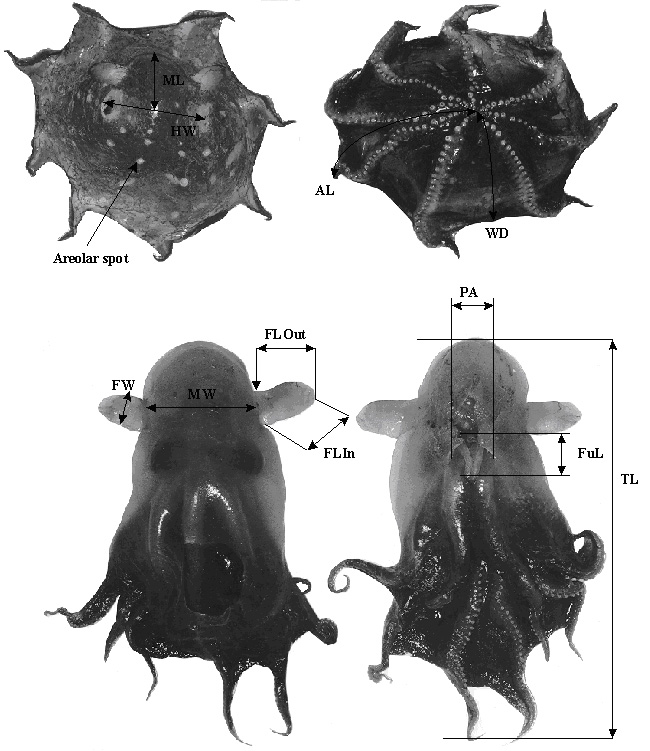 top: Opisthoteuthis sp.; bottom: Grimpoteuthis sp. Raw measure delineation points. Legend: AL (arm length), FLIn (fin length inner), FLOut (fin length outer), FuL (funnel length), FW (fin width), HW (head width), ML (mantle length), MW (mantle width), PA (pallial aperture width), TL (total length), WD (web depth). |
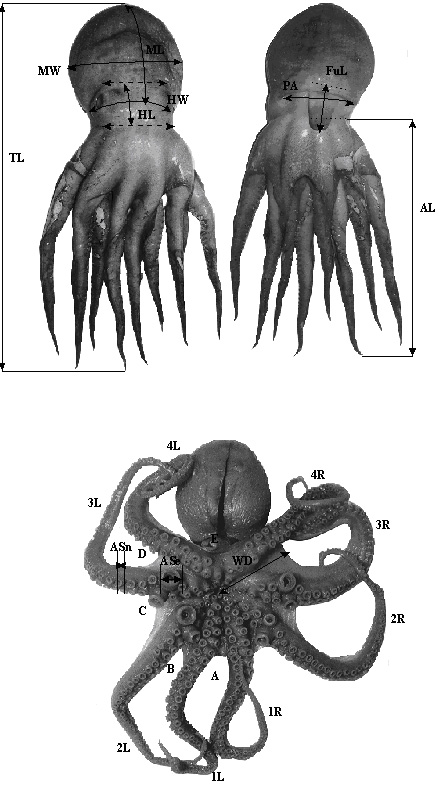 Figure 2 (click image to enlarge) top: Graneledone sp.; bottom: Octopus (s.l.) campbelli (Smith). Raw measure delineation points. Legend: A-E (web sectors A through E), AL (arm length), ASe (enlarged sucker diameter), ASn (normal sucker diameter), FuL (funnel length), HW (head width), ML (mantle length), MW (mantle width), PA (pallial aperture width), TL (total length), WD (web depth), 1-4R/L (arms 1 through 4 right or left). |
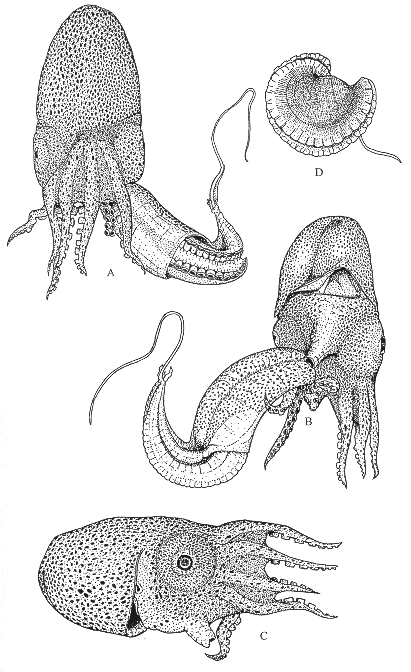 Figure 3 (click image to enlarge) Argonauta nodosa Solander, 1786 - In conventional incirrate (non-finned) octopuses the distal-most portion of the third right (or rarely third left) arm is hectocotylised. In the male of Argonauta (the Paper Nautilus) the entire third left arm is modified. This individual, fully mature, of mantle length (ML) 13.5 mm shows this grossly enlarged hectocotylised arm. A detached hectocotylus recovered from the mantle cavity of a female is depicted in illustration D. |
 Figure 4 (click image to enlarge) The first two images (upper left and centre) are of a species of Pareledone, a genus of octopus that has a single row of suckers only. Many genera of octopus are characterised by a single row of suckers (eg., Pareledone, Eledone, Graneledone, Thaumeledone), although most genera and species that are readily available for purchasing as pets possess the standard two rows. The image on the upper right is a close up view of the tip (the hectocotylus) of the third right arm of a species of Benthoctopus (a deep-water genus of octopus characterised by possessing suckers arranged in two rows, and in lacking an ink sac): CAL = calamus; LIG = ligula; SG = spermatophore groove. Within the mantle of the octopus both the alimentary canal and reproductive systems are located. To describe a species these must be dissected from the mantle; each has many important characters and character states that enable accurate identification of a species. The image to the lower left is of the alimentary canal (Graneledone taniwha, a species that also lacks an ink sac), and that to the right of the female reproductive system (Octopus kaharoa). Abbreviations in illustrations are: AN, anus; ASG, anterior salivary gland; BB, buccal bulb; BK, beak; CD, caecal duct; CR, crop; DG, digestive gland; DO, distal oviduct; EGG, egg; INT, intestine; OB, oviducal ball; OES, anterior oesophagus; OS, ovary sac; PO, proximal oviduct; PSG, posterior salivary gland; SC, spiral caecum; SD, posterior salivary gland duct; ST, stomach. |
 Figure 5 (click image to enlarge) The first image (top left) is the alimentary canal of a cirrate (finned) octopus (Grimpoteuthis abyssicola); it lacks an ink sac, and apparent salivary glands. The intestine of Grimpoteuthis is short relative to the length of the anterior alimentary canal (oesophagus and crop), an important character state for differentiating otherwise similar-looking cirrate genera. The image on the upper right is the male reproductive system of Graneledone challengeri; that on the lower left is the male system of the finned Opisthoteuthis mero; the two differ noticeably. The female reproductive system in octopuses is generally considered to be conservative. However, marked differences do occur in the relative lengths of the proximal and distal oviducts, the number of oviducts (one in cirrate octopuses, two in incirrate octopuses), in egg size and shape, and in the position that the system occupies in the visceral mass. The two images, lower centre (Tremoctopus robsonianus) and lower right (Grimpoteuthis abyssicola), illustrate some of the differences that can be expected in different types of octopus (and these two illustrations can be compared with the earlier image in Figure 4, Octopus kaharoa). Abbreviations in illustrations are: AG, accessory gland; AGC, accessory gland complex; AN, anus; BB, buccal bulb; CR, crop; DG, digestive gland; DO, distal oviduct; DVD, distal vas deferens; EGG, egg; INT, intestine; OB, oviducal ball; OES, oesophagus; OS, ovary sac; P, penis; PD, penis diverticulum; PO, proximal oviduct; PVD, proximal vas deference; SC, spiral caecum; SG, spermatophoral gland; SS, spermatophore sac; ST, stomach; SVC, seminal vesicle complex; TS, testis sac. |
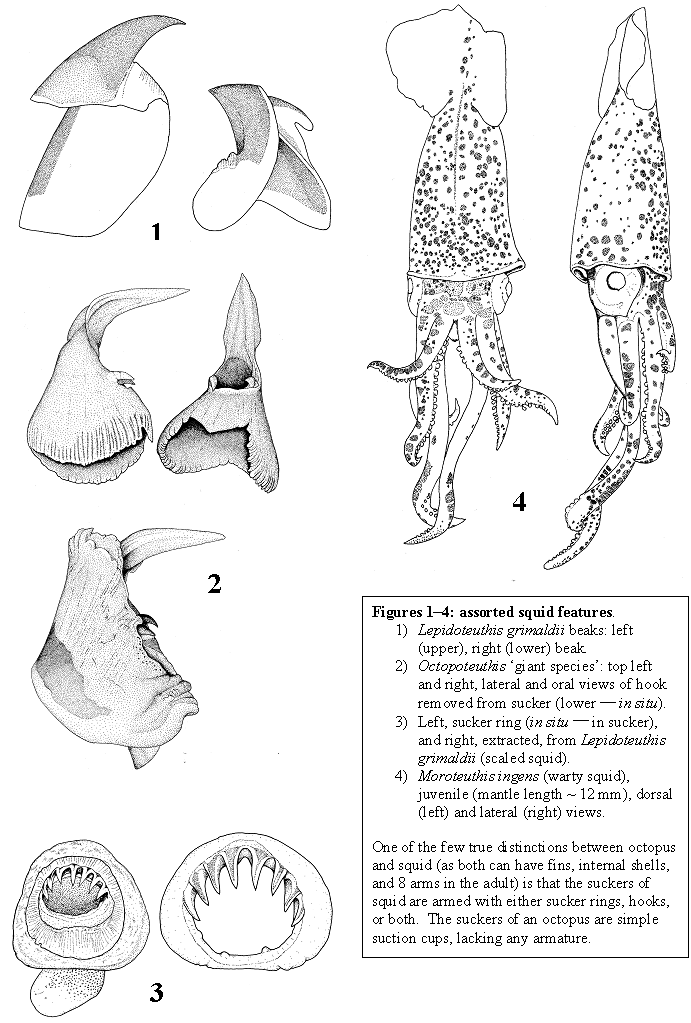 Figure 6 (click image to enlarge) One of the few true distinctions between octopus and squid (as both can have fins, internal shells, and 8 arms in the adult) is that the suckers of squid are armed with sucker rings, hooks, or both (the suckers of an octopus are simple suction cups, lacking any armature). Figure 6 depicts the beaks, hooks, sucker rings and general body morphology of some interesting squid (genera Octopoteuthis, Moroteuthis and Lepidoteuthis). Beak shape, and arm and tentacle hook and sucker ring morphology are enormously variable, and are some of the most important characters that are used to identify species. Because squid have many additional hard parts (as in sucker rings and hooks), in addition to often possessing photophores, the majority of species descriptions detail external and hard-part morphological characters only (as opposed to octopuses, where descriptions essentially include soft-part anatomical detail). |
| As a detailed, annotated account is presented by Roper & Voss (1983), emphasis here is made on defining points of reference used to measure characters or ratios, and in defining new character states employed in species descriptions. Definitions of indices in bold type are modified from definitions provided by Roper & Voss (l.c.). |
ACRONYM DEFINITIONS AND DERIVATIVES
| AF | Arm Formula: comparative length of arms expressed numerically in decreasing order (see AL): arm 1 (dorsal), 2 (dorso-lateral), 3 (ventro-lateral), 4 (ventral); e.g. 1.3.4.2., 2.3=4.1. |
| AL | Arm Length - arm length measured from beak to tip of arm. ALI, Arm Length Index - AL as a percentage of ML. ALI1-4, Arm Length Index arms 1 to 4 - range of arm length indices, longest to shortest. |
| AS | Arm Sucker diameter - diameter of arm suckers (e = enlarged, n= normal). ASIe, Arm Sucker Index (enlarged) - diameter of largest enlarged arm sucker on each designated arm as a percentage of ML. ASIn, Arm Sucker Index (normal) - diameter of largest normal arm sucker (not enlarged) on each designated arm as a percentage of ML. ASIn1-4, Arm Sucker Index (normal) 1 to 4R/L - range of ASIn values arms 1 to 4 R or L. |
| ASC | Arm Sucker Count - number of suckers along each entire intact designated arm (to arm tip)1, e.g. ASC2R, total arm sucker count arm 2 right. ASC1-4, Arm Sucker Count 1 to 4R/L (ex. 3R or L male hectocotylised arm, see ASC 3R or L) - range of arm sucker counts excluding counts on hectocotylised arm of male 3R or L. ASC3R (or 3L), Hectocotylised Arm Sucker Count - number of suckers along entire arm (to calamus). |
| CaL | Calamus Length - measured from last (distal-most) sucker to calamus distal tip. CaLI, Calamus Length Index - calamus length (CaL) as a percentage of ligula length (LL). |
| CiL | Cirrus Length - length of longest cirrus on each arm. CiLI, Cirrus Length Index, CiL as a percentage of the diameter of the largest normal sucker (or mantle length2, whichever designated). |
| EO | Eye Orifice diameter - diameter of the opening of eye. |
| FL | Fin Length - measured along axis of fin. FL In, Fin Length Inner, greatest length along anterior margin of fin measured in straight line. FL Out, Fin Length Outer, greatest length along posterior margin of fin measured in straight line. FLI In3, Fin Length Index Inner, FL In as a percentage of ML. FLI Out, Fin Length Index Outer, FL Out as a percentage of ML. |
| FuL | Funnel Length - the length of the funnel from the anterior opening to the posterior border measured along the ventral midline. FuLI, Funnel Length Index - FuL as a percentage of ML. |
| FW | Fin Width (CIRRATES only) - greatest width across one fin perpendicular to axis of fin. FWI, Fin Width Index, FW as a percentage of fin length. |
| GiLC | Gill Lamellae Count - number of lamellae on inner and outer demibranchs excluding4 the terminal lamella(e), e.g. 7 outer, 7 inner. |
| HdL | Head Length - diameter of orbits along antero-posterior axis of body5. HdLI, Head Length Index -HdL as a percentage of ML. |
| HdW | Head Width - greatest width of head at level of eyes. HdWI, Head Width Index - HdW as a percentage of ML. |
| LL | Ligula Length - measured from distal-most sucker to tip of arm. LLI, Ligula Length Index - LL as a percentage of hectocotylised arm length. |
| ML | Mantle Length - measured from midpoint between eyes to posterior end of mantle. |
| MW | Mantle Width - greatest straight-line (dorsal) width of mantle. MWI, Mantle Width Index - MW as a percentage of ML. |
| OAI | Opposite Arm Length Index - length of hectocotylised arm as a percentage of its fellow arm on opposite side. |
| PA | Pallial Aperture extent - the measurement between the points of attachment of the mantle to the head along the ventral margin of the mantle. PAI, Pallial Aperture Index - PA as a percentage of ML. |
| TL | Total Length - measured from end of longest arm to posterior end of mantle. |
| WD | Web Depth - measurement of deepest web sector from beaks to to midpoint of sector (Web sector A, dorsal to dorsal arm; B, dorsal to dorso-lateral arm; C, dorso-lateral to ventro-lateral arm; D, ventro-lateral to ventral arm; E, ventral to ventral arm). WDIA-E, web depth range sectors A-E. |
| WF | Web Formula - comparative depth of each web sector expressed alphabetically in decreasing order (see WD). WFR/L, right and left web formulas. |
One possible way of defining the size of an octopus, to standardise peoples reference when dealing with size, would be in accordance with the following:
| Size | TL (mm) |
| Small | <200 |
| Small to moderate | 200-300 |
| Moderate | 300-500 |
| Moderate to large | 500-600 |
| Large | 600-1000 |
| Massive | >1000 |
2 Differs in not employing mantle width.
3 Differs by dividing fin length measures by mantle length as opposed to head width; head width in species of Opisthoteuthis is somewhat indefinable owing to the anterior-posterior compression of the cephalopedal mass.
4 Differs by excluding the terminal lamellae from inner and outer demibranch lamella counts.
5 Differs in head length being indefinable in many instances in octopods.
- Original publish date
- Nov 27, 2002
