By Phil Eyden
Note: Phil welcomes discussion on this article in the Fossils and History forum on the Message Board.
Introduction
Folkestone is located at the extreme southeast tip of England. It is a port-town with a small harbour and is roughly about 30 miles away from France. Folkestone is a very historical town, the area having been settled at least since the Bronze Age and there is evidence of Roman occupation in the shape of a large villa overlooking the harbour slightly to the north of the town. This lies buried between to two Napoleonic defensive Martello-Towers that overlook the sheltered East Wear Bay, and some of the most productive and interesting fossil beds in the UK. The geology of the area is quite interesting with a sequence of varying rock types along a couple of miles of seashore.
The earliest rocks at Folkestone consist of Lower Greensand exposed to the north of the town and run through a sequence of Lower Greensand, Gault Clay (phasing into Upper Greensand) and Chalk, the whole sequence dating from approximately 120 to 80 million years old. The chalk increases in thickness to the north culminating with the famous white cliffs of Dover before dipping off to the north approaching Deal. The complex geology of the area has caused landslips, the impervious clay sandwiched between the Lower Greensand and the chalk has been known to slip under the enormous pressure causing landslides in an area known as 'The Warren'; it is alleged that the railway line that cuts through this area en route to London is extremely expensive to maintain due to the continual maintenance and surveillance needed on the track due to ground slippage. The Gault Clay beds themselves are exposed onto the beach for roughly a third of a mile or so around a rounded headland known as Copt Point that is the highest point in the cliffs, the exposures directly below the Point being the most productive beds.
Gault Clay
It is the Gault Clay that is of particular interest; it is a dark blue-grey colour and has been extensively studied. The clay consists of mudstones with layers of phosphate nodules that delineate the margins of some of the clay beds, the whole Gault sequence achieves a thickness of 40m in places. The clay has been sub-divided into thirteen individual beds, each containing diagnostic fossil species and dates from the Middle to the Late Albian of the Cretaceous period, approximately 108-97.5mya. The clay from the Middle Albian is known as the Lower Gault and the beds from the Late Albian are known as the Upper Gault. The Upper Gault is more calcareous than the Lower Gault mudstones and is somewhat lighter in colour. Although both the greensands and chalk all contain fossils including ammonites, the preservation is by far the best in the clay.
During the Albian period of the Cretaceous much of what is now southern Britain and northern Europe lay under a shallow warm sub-tropical ocean and would have been populated with numerous islands. Following the break-up of Pangea, when all the continents were locked together, the Earth underwent a rapid climate change from a cool period to a very warm period. The Gault clay was laid down in an increasingly warm sub-tropical environment when the polar caps were melting, the global sea level was rising, the North Atlantic was starting to form and a connection between the North Sea basin and the oceans to the south was widening. This European ocean had been fairly isolated hitherto this time and many of the species that are found were unique to the area. The clay was formed due to deposition of minute fine mud particles washed in from the land by river action, closer to the coasts the particles were heavier and slowly amalgamated to form the greensands. These finer mud particles were transported a greater distance out to sea and were deposited further from the coast at greater depths.
The Gault contains the fossils of many forms of marine creature; ammonites, belemnites, nautilus, bivalves, crinoids, gastropods, fish remains, and scaphopods are quite common along with rare finds of reptilia. Ichthyosaur vertebrae have been found in association with the smaller fauna though by far the most common fossils are the small shelly forms. In some of the clay bed sequences the fossils are preserved in phosphate; they tend to be dark, frequently broken and are often in concreted masses. The best preserved fossils are those that are pyritised, the preservation of these pyritised animal remains in the some of the Lower Gault beds is exceptional, shells tend to be preserved in their original proportions and are generally not crushed. Sometimes a beautiful coating of iridescent mother-of-pearl is to be found though this is usually partial or flaked off entirely. They do require careful preservation (more on that subject later).
Ammonites
The ammonite fauna is quite diverse with many different species present. During the later part of the Lower Cretaceous the ammonites suddenly radiated with a rapid burst of evolutionary activity, the most common group of ammonites found at Folkestone were part of this phase. Many of the local ammonites belonged to the Hoplitaceae, a European ammonite super-family that that is characterised by its highly ornamented, generally spiky form, small size and tubercles. The Hoplitaceae, a long lived and true ammonite family, thrived from the Early Albian but went into decline towards the Late Cretaceous becoming extinct at a date of roughly 83 million years ago. The extent of the domain of this super-family stretched across European waters from the recently separated North America (members of this ammonite group have been found in Florida) to at least as far as Iran and central Asia, and is known as the 'Hoplitinid Province' by palaeontologists. The specific species of the Hopitidae that one finds at Folkestone tend to be confined to the Gaultexposures across Southern England and Northern France in the so-called 'Paris Basin'. It is believed that this super-family of ammonites probably frequented warm sub-tropical waters above the continental shelves.
There are a number of variations within the Hoplitidae that can be found at Folkestone, with genera of the strongly ribbed Hoplites, the smoother more delicate looking Anahoplites and the robust, ribbed and spine-bearing Euhoplites being the most common. Other members of the group that can be found include Dimorphoplites, Epihoplites and Otohoplites. None of the species belonging to these groups were very long lived, it is estimated that many of these ammonite forms lived only a few hundred thousand years, hence they can be used as a useful tool in stratigraphy in attempting to determine layers; various beds in the Gault clay each has its own 'marker' species.
Not all the ammonites are from this family. There is a wide range of other ammonites, notably the strongly ribbed Hysteroceras, a member of the Acanthocerataceae. Also from this family, the ammonites Mortoniceras and Dipoloceras with heavy keels on their shells are not uncommon, though usually fragmentary. Increasingly common in the Upper Gault, the Acanthocerataceae slowly replaced the dominant Hoplitaceae which are more common in the Lower Gault. Representatives of other true ammonite families of Placenticerataceae, Desmocerataceae and Haplocerataceae can also be found though in much fewer numbers. Some heteromorphfamilies are also strongly represented; the Turrilitaceae are partly represented by Hamites, a very common find though is very rarely found intact. The fragile elongated hooked 'G' shape of this ammonite means that it is very prone to fragmentation and normally one can only find small sections. Other heteromorphs that can be found include Protanisoceras, Idiohamites and Anisoceras.
Other cephalopods
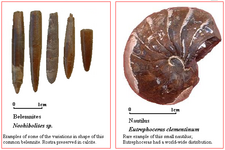
Belemnites are extremely common; one would be unlucky indeed not to find one within five minutes of studying the clay outcrop. These belemnites are normally 2-4cm in length and are one of the smallest genus, Neohibolites. Marked variations in the shape of the tip of the rostrum makes identification of individual species possible. These belemnites are extremely resistant and wash out of the cliffs to become a common find in the shingle amongst the boulders on the beach. The calcite belemnite rostra have a translucent quality and sometimes traces of the internal structure and phragmocone can be determined. Neohibolites had a worldwide distribution and probably lived in vast shoals on the warm continental shelves from a date of about 112 million tears ago in early Albian through to the succeeding Cenomanianperiod of the Cretaceous, probably becoming extinct about 93.5 million years ago.
Nautilus specimens are rarely found and are much more uncommon than ammonites, nonetheless at least one genus is known, Eutrephoceras clementinum. Interestingly, unlike the ammonites, this nautilus had a worldwide distribution and other examples of species of this nautilus are known from areas as geographically separated as Wyoming and the Chatham Islands near New Zealand. Eutrephocerasbears a close similarity to the modern nautilus with a very similar shape to the shell, though a little more globular, and it is generally believed that the modern nautilus is a direct descendant of this ancient animal.
Other animals
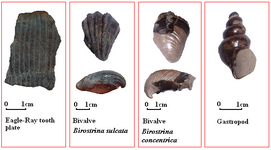
Ammonites are by no means the only fossils that can be found. Although one would be fortunate indeed to find an ichthyosaur vertebra these are not unknown as are occasional rare finds of turtle remains and plesiosaur bones. The majority of the fossils are of small marine invertebrates; aside from cephalopods the most common fossils one can find are phosphatised bivalves. The bivalve Birostrina suculata is a common find, this clam is easily recognised by the heavy fluting on the shell halves. Gastropods, scallops and oysters can also be found along with many other forms of bivalves, these occasionally retain their mother of pearl covering. Scaphopods, tiny marine molluscs living inside tapering white tube tubes are easily found in the clay outwash, these are of the genus Dentalium and are very similar to modern scaphopods. Crinoid 'sea lily' stems are fragmentary and usually only a couple of centimetres in length but usually preserve the star shaped structure well. In addition, fish teeth are common, usually a jet black in colour, and sharks teeth are not uncommon though usually very small, best collected from the clay outwash. Solitary corals can be found sometimes concreted into nodules. Crustaceans are rare finds but are frequently well preserved.

Preservation
Many of the fossils are preserved in black phosphate, these merely require cleaning and no further treatment. Some of the Gault layers contain fossils, frequently crustaceans, in small brown pebble sized nodules. These can be cracked open with caution with a hammer but one must be prepared to lose the odd specimen. Frequently these nodules are harder than the fossil inside, so shattering is common.
As mentioned above, the best fossils including many ammonites are those that are preserved in iron pyrites. These can cause problems as if left untreated as they will disintegrate over a year or two as iron pyrites is inherently instable when exposed to air. Prolonged exposure to oxygen without some form of protection from lacquer or varnish will lead to a creeping decay and slow disintegration. One can't just wash them and leave them, unfortunately. Fossils are best left to soak for a week or so in fresh water which should be enough time to remove the salts that also accelerate decay. One can usually tell when this is happening, as tiny bubbles tend to form on the surface of the fossils, after a few days this ceases. Then leave them to dry, and should be treated with lacquer, a mixture of PVA and water, or can be varnished with modelling varnish. If you use this approach, satin varnish gives a nicer effect than gloss. The fossils can then be mounted in display boxes, with a label. This keeps the fossil in a sealed environment and prevents it from being knocked about and damaged.Boxes are available from many mineralogy suppliers; if ordering from within the United Kingdom UKGE Ltd is a good source of inexpensive display cases.
Going there.......
If anyone is thinking of going to site please be aware that the site is poorly accessible. Although parking is very easy along the side roads overlooking East Wear Bay, access to the beach involves a hike down muddy paths and steep slopes. The Gault Clay is exposed around a rock-strewn headland that one can only cross safely if the tides are in retreat, and preferably at a quite low level. Much of the beach is strewn in very large boulders that are very slippery as they tend to be encrusted with seaweed. It is very easy indeed to slip and sprain an ankle, or worse! The cliffs themselves should be treated with caution as the clay can subside, especially after heavy rains and are not at all stable. Climbing the cliffs should not be undertaken at all. In addition, good footwear with heavy tread is essential. Always take note of the tides as the area can be cut off during a spring tide. Always take a mobile phone and, if possible, a high visibility jacket – just in case!
Fossils are best collected from the beach as opposed to the cliff itself as wave and rain action tends to wash specimens into the shingle in between the boulders on the beach. Turning over stones and careful scrutiny of the clay outwash amongst the shingle usually produces the best results. One really does not require a hammer or pick, a trowel will suffice to sort through the stones and sediment. A bottle of tap water is also advisable to wash finds on the spot if one is curious and wishes to wash the clay off there and then. One is advised to take a bag and newspaper to keep the specimens safe and free from knocking into each other.
Above all, be careful, but have fun. Just ensure you post images of what you find here first!
Links
Fossils of the Gault Clay and Folkestone Beds, UK.
Very detailed look at Folkestone fossils and the stratigraphy of the area including many stunning images. Very useful for finds identification.
Ammonite.ws
Adders.org: Folkestone Fossils.
A nice short guide to Folkestone Fossils for kids:
http://web.ukonline.co.uk/conker/fossils/folkestone-fossils.htm
UK Fossils guide to Folkestone.
Plenty of excellent images of location and site available here:
UK Fossil Collecting
Geology of Kent and the Boulonnais.
Detailed look at the geology of Kent including a comprehensive examination of the stratigraphy of the Lower Greensand, Gault Clay and Chalk:
http://www.geologyshop.co.uk/geolkb.htm - gaultf
Les Ammonites du Cretace
More fantastic photographs of Lower Cretaceous Albian ammonites are available on this French site:
http://f.diebold.free.fr/06Alb.html
http://f.diebold.free.fr/000taxons.html
Discovering Fossils UK
Excellent site for information on all aspects of fossil hunting in the UK. Although the site is primarily UK specific, the guidelines, techniques and background information should be of interest and use to all prospective fossil hunters:
Discovering Fossils | Introducing the palaeontology of Great Britain
Credits
PaleoGlobe adapted from Dr Ron Blakely's Home Page: http://jan.ucc.nau.edu/~rcb7/RCB.html
Thanks to Mandy Whall for the loan of the Anahoplites planus specimen.
Thanks to the barking mad Daisy the Dog for providing scale in the stratigraphy photograph and providing on-site entertainment by straddling a rock and struggling vainly whilst unable to free herself.
Phil Eyden
April 2004
- Original publish date
- Apr 24, 2004